
Breastfeeding with Large Breasts
A widespread misconception among many women is the belief that large breasts are more suitable for breastfeeding, make breastfeeding easier, and produce more milk. In reality, these assumptions are unfounded and do not accurately reflect physiological facts. On the contrary, large breasts can often create significant challenges for breastfeeding comfort during the lactation period.
Lymphatic Drainage Interventions
Larger breasts can make it harder for the baby to latch on and for the mother to manage breastfeeding. In addition, the accumulation of interstitial fluid is more common in large breasts, which creates a need for additional lymphatic drainage maneuvers. These maneuvers are performed to soften and decompress the breast, after which breastfeeding can be carried out.
You may read more about the role of the lymphatic system in breastfeeding in our detailed article on this topic. It should also be emphasized that, often, this interstitial fluid is mistakenly interpreted as milk; that is, the fluid accumulated between the tissues of the breast is perceived as stored breast milk. In reality, this is not the case. For effective breastfeeding to occur, this fluid needs to be displaced.
To reduce breast swelling, alleviate fullness, and soften the breasts to facilitate the infant’s suckling, we recommend watching the lymphatic drainage massage technique demonstrated by lactation consultant Lucy Webber.
Reverse Pressure Softening Technique for the Nipples
Let us return to the effective implementation of breastfeeding with large breasts. For this purpose, there are several simple and comfortable methods. These measures can significantly alleviate the difficulties of breastfeeding from large breasts and provide comfort for both the infant and the mother during feeding. Excessive milk accumulation hinders the infant’s ability to achieve a deep latch. In such cases, reverse pressure is first applied to the breast, particularly to the areola, that is, the darker area around the nipple. Reverse pressure displaces the fluid in the areolar tissue and ensures that the areola becomes softer and less tense. As a result, the infant is able to latch onto the breast more deeply. You can view the reverse pressure softening technique applied to the nipples in the video below:
The Rolled Towel Technique
As a next step, to facilitate the infant’s sucking from large breasts, once partial softening of the areola is felt, a rolled towel is placed under the breast before positioning the infant at the breast. A question may arise: “What is the purpose of this towel?” The towel provides additional support to the breast and prevents it from “spilling” over the infant’s face. On the contrary, by partially bearing the weight of the breast, the towel enables the infant to manage it more easily, making breastfeeding more comfortable and effective.

Proper Breast Holding Position
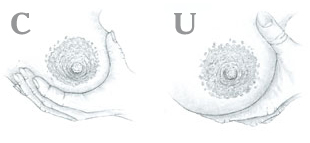
When breastfeeding with large breasts, it is essential for the mother to support the breast manually. The breast may be held either in a “U-shaped” or a “C-shaped” position. Maintaining the breast in this manner during breastfeeding enables the infant to suckle more comfortably and provides the mother with a more effective and less painful breastfeeding experience.
If you experience difficulties breastfeeding with large breasts, we strongly recommend trying these methods. If you have experience breastfeeding with large or engorged breasts, please share in the comments.
Author: Saltanat Zulfugarova
Breastfeeding Consultant